Paolo Calvi

Paolo Calvi

Paolo Calvi is an Italian journalist, author and independent researcher whose work examines the structures through which technology, knowledge, economic power and institutions shape human experience. His current research focuses on artificial intelligence not simply as a technological development, but as an intellectual problem: one that challenges established ideas of intelligence, language, creativity, authorship, agency and meaning. He is the founder and author of The Machine Question, an independent research project devoted to understanding what changes when intelligence becomes something that can be modelled, engineered and increasingly delegated to machines. Rather than approaching artificial intelligence primarily through the succession of models, products and technological breakthroughs, his work investigates the deeper structures beneath them: the relationship between computation and understanding, information and knowledge, prediction and reasoning, machine production and human creation. Calvi’s approach is deliberately interdisciplinary. His writing moves across philosophy of mind, artificial intelligence, economics, technological governance and the study of institutions, treating these fields not as separate domains but as different perspectives on a common transformation. A recurring concern throughout his work is the distinction between what a system can produce and what it can be said to understand — and, consequently, whether the emergence of increasingly capable artificial systems requires us to reconsider not only machines, but the categories through which human beings have historically understood themselves. This perspective is informed by a professional background spanning journalism, finance, corporate communication, digital transformation and emerging technologies. Calvi is Editor-in-Chief of GrifoNews and Director of Communication, Brand and Editorial at GrifoFinance. His professional work has brought him into sustained contact with the institutional and economic consequences of technological change, including artificial intelligence, cybersecurity, financial technology and digital governance. He also works as a senior adviser to companies, financial institutions and insurance organisations on digital transformation, AI governance, cybersecurity and regulatory compliance. This proximity to the practical deployment of technological systems informs, but does not determine, his intellectual work: The Machine Question deliberately occupies the space between technical analysis and philosophical inquiry, where questions of capability become questions of meaning, responsibility and power. Calvi is the author of essays and books on artificial intelligence, technology and the philosophical implications of scientific knowledge, including L’Universo Pensante (2024). His wider research extends to the mechanisms through which societies construct authority, value and knowledge — an interest that connects his work on intelligent machines with his writing on economics, institutions, culture and human agency. At the centre of his work lies a simple methodological conviction: artificial intelligence cannot be understood by studying machines alone. Every serious inquiry into machine intelligence eventually becomes an inquiry into human intelligence — into what we mean by understanding, creativity, judgement and consciousness, and into which of these concepts remain meaningful when some of their outward manifestations can be reproduced computationally. The Machine Question is the continuation of that inquiry.

Intelligence as a Social System

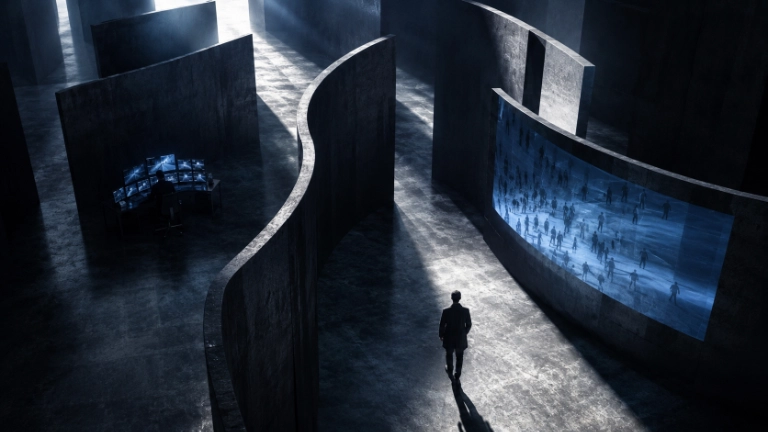
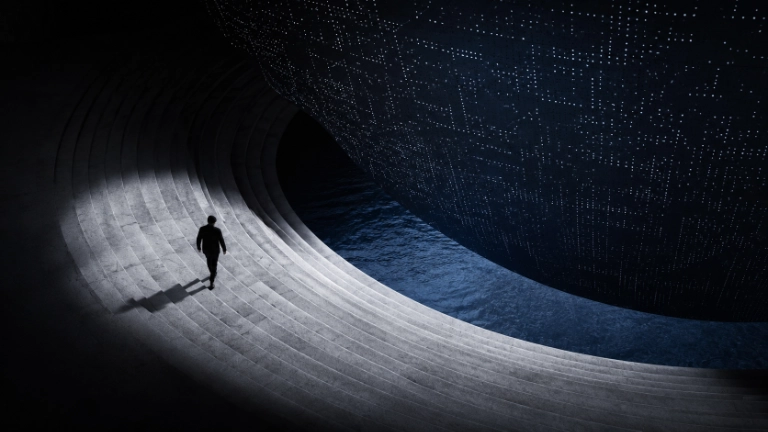
Artificial intelligence and power depicted as a lone figure navigating a vast monitored institutional space.

Artificial intelligence is not merely a technological capability. Its development depends on control over compute, data, models and the institutions that decide what counts as knowledge, intelligence and authority. This essay examines AI as a social system in which technology, economic interests and symbolic power become structurally inseparable.
The Human Boundary

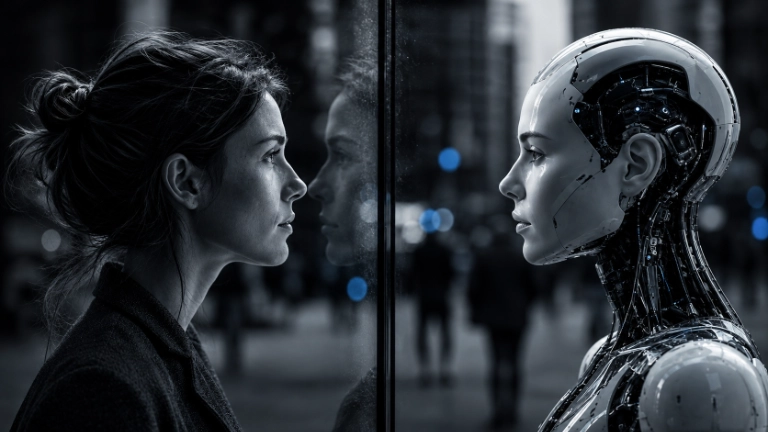
What makes us human in the age of AI: a woman and a humanoid robot face each other across a glass divide.

As machines acquire capacities once treated as uniquely human, the boundary of personhood becomes harder to defend through intelligence, language or creativity alone. This essay asks whether what matters instead lies in consciousness, continuity, responsibility and the relational practices through which persons are recognised.

Creativity After Generative AI

AI creativity represented by a lone figure moving beneath a vast computational structure in a dark architectural space

When machines can generate images, texts and music, the old idea of creativity as the expression of a single author begins to fracture. This essay traces that fracture through Kant, Barthes, Foucault, Boden and Dickie, asking what remains once generation, intention and institutional recognition no longer coincide.

The Language Problem

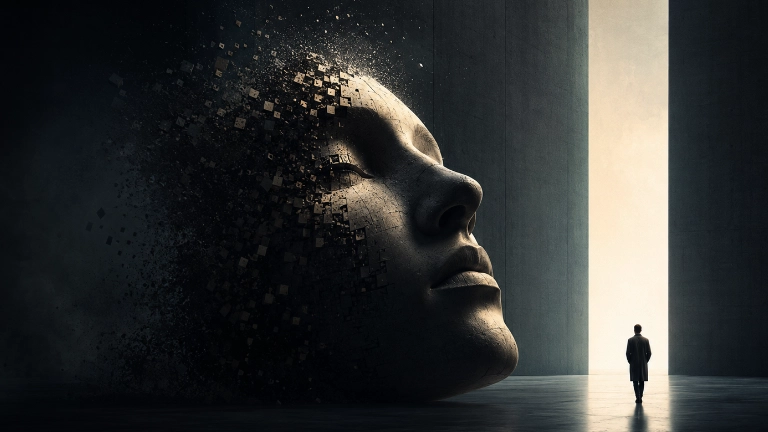
Artificial intelligence represented by a monumental human face dissolving into fragments beside a solitary figure.

Language models can master linguistic structure and participate in human linguistic practice. Whether their words refer to anything beyond that structure is a different question.

The Architecture of Intelligence

Machine understanding: a solitary figure facing a monumental opening filled with natural light

Understanding does not emerge at the end of a cognitive pipeline. Perception, memory, representation, language, inference, learning and context continuously constrain one another. This essay examines that architecture and proposes a different way to evaluate intelligence in humans and artificial systems.

The Machine Question

Artificial intelligence does not simply create new machines. It forces us to reconsider what intelligence means, how we define understanding, and which assumptions about human cognition remain valid in an age of artificial systems.